
Overview
Philanthropy often makes headlines for the size of donations and funding commitments made towards charitable causes. In May 2026, the Ministry of Finance reported that donations received by Singapore charities reached S$3.7 billion in Financial Year 2024, surpassing the pre-pandemic high of S$3.2 billion in Financial Year 2019. In July 2026, the National Volunteer and Philanthropy Centre reported that businesses recognised as Companies of Good had collectively contributed nearly S$384 million in donations over the preceding three years.
The figures highlight substantial financial support for social causes, but they tell only part of the story. These same Companies of Good contributed more than S$85 million in in-kind donations and over 1.1 million volunteer hours. These contributions point to a wider conversation about the resources that organisations can bring to social causes beyond just funding.
The fifth edition of Singapore’s Biggest Philanthropic Organisations focuses on Philanthropy at Work, highlighting the growing trend of philanthropic organisations going beyond pure grantmaking to create greater social impact. As philanthropic organisations take on more active and collaborative roles in addressing social needs, this latest edition expands its rankings to include both Grants Disbursed and Total Expenditure (Annual), providing a broader perspective on how philanthropic resources are deployed.
The Grants Disbursed ranking maintains continuity with the 2022, 2024 and 2025 editions, while the Total Expenditure ranking builds on the first edition in 2021, when expenditure was used as the basis for ranking philanthropic foundations.
Beyond Funding: Putting Capabilities to Work
In deciding how best to address social needs, philanthropic organisations are increasingly looking beyond funding to consider the capabilities required to create meaningful impact. This involves assessing what expertise, resources and networks they can bring to the table, as well as identifying the complementary strengths that other organisations can contribute. Depending on these considerations, they may choose to develop programmes directly, support existing organisations, invest in capacity-building or bring together partners with different areas of expertise.
Taking a more active role in philanthropy does not necessarily mean implementing programmes themselves. Charities and community organisations often have valuable frontline experience, established relationships and a deeper understanding of the communities they serve. Greater impact may be achieved by combining these strengths with the financial resources, expertise and networks of philanthropic organisations, allowing each party to contribute where it can add the most value. For example, Quantedge Foundation combines multi-year funding with practical support for social innovators. Through its Philanthropreneur-in-Residence initiative, it provides programme development and organisational capacity-building support alongside funding, helping social impact organisations strengthen their capabilities to develop and sustain their work.
Another approach involves leveraging business networks and expertise to create opportunities for communities. SBF Foundation, for instance, draws on its connections with the business sector to support social initiatives. Through programmes such as EmployWell, it brings together employers and community partners to support individuals facing employment barriers. Its Community Marketplace also facilitates connections between businesses and community organisations, illustrating how philanthropic organisations can serve as connectors and mobilise resources beyond financial contributions.
Philanthropic organisations with established business operations can also leverage their infrastructure and service networks to support communities. NTUC Enterprise supports the social mission of NTUC of helping workers earn a better living and live a better life through its portfolio businesses and giving vehicles (NTUC Community Fund, FairPrice Foundation and Income OrangeAid), drawing on its capabilities in food retail, early childhood education, healthcare, eldercare and financial protection. These existing operations provide opportunities to reach beneficiaries through services they use in their everyday lives. The following case study illustrates how NTUC Enterprise combines these capabilities with external partnerships to translate business reach into direct community impact.
Case Study: NTUC Enterprise – Putting philanthropy to work through everyday connections
Guided by its purpose to Enable Better Living, NTUC Enterprise (NE) plays an active role in advancing NTUC’s social mission of helping workers earn a better living and live a better life. NE supports this social mission of the broader Labour Movement by anchoring an extensive ecosystem of care that provides goods and services in areas such as groceries, healthcare, childcare and financial services. Through its role as the holding entity for impact businesses, charities, and investments and its core giving vehicles, the NTUC Community Fund, FairPrice Foundation and Income OrangeAid, it draws on established operating capabilities and multi-sector partnerships to develop, test and scale community solutions. In FY2025, these entities disbursed nearly S$23 million across various initiatives, translating business reach into direct community impact.
The choice of giving approach begins with an assessment of community needs and who is best equipped to respond. NE’s businesses collectively serve over 70% of households in Singapore, providing an extensive network of everyday touchpoints backed by operating expertise. FairPrice Foundation keeps daily essentials within reach through targeted discounts for lower-income individuals and households at FairPrice supermarkets. Amongst its many initiatives, NTUC Community Fund provides additional learning support for children with developmental needs through NTUC First Campus’s preschool network, and helps eligible seniors meet care costs through NTUC Health. These connections make support accessible where people already shop, learn and receive care.
Where addressing community needs requires specialist expertise, the giving vehicles work with partners whose strengths complement their own. FairPrice Foundation’s Neighbourhood Food Share initiative connects FairPrice Group’s food resources and logistics with grassroots organisations that distribute produce locally. Combining these capabilities extends what each organisation could achieve on their own.
NE’s philanthropy also strengthens the wider care sector. Announced in July 2025, Income Insurance’s S$10 million commitment funds the Income OrangeAid Caregiver Support Accelerator Grant, drawing on the National Council of Social Service’s sector knowledge and social service agencies’ caregiving expertise. Multi-year funding, accelerator workshops and outcome measurement help agencies refine programme design and assess results, building their capacity to sustain effective caregiver support in families.
NE also supports experimentation and shared learning to improve how community needs are addressed. NTUC Community Fund supports early childhood inclusion through practical resources, pilot interventions and collaboration with preschool operators, researchers and community partners. Building evidence and sharing effective practices can play a catalytic role in improving provision across the sector, extending philanthropy’s contribution beyond NE’s own ecosystem and the programmes it directly funds.
Through its philanthropy, NE supports children and youth, families and workers, caregivers, seniors and the wider community. Together, its giving vehicles – NTUC Community Fund, FairPrice Foundation and Income OrangeAid – contribute to a holistic network of support for vulnerable people across life stages. They put philanthropy to work through everyday connections, drawing on NE’s business capabilities and touchpoints alongside community partners’ expertise and reach. Their collective efforts address immediate needs while strengthening the organisations and practices that sustain support as people’s circumstances change.
Singapore’s Biggest Philanthropic Organisations List (2026)
The fifth edition of Singapore’s Biggest Philanthropic Organisations List covers private philanthropic entities registered in Singapore, presenting rankings based on both Grants Disbursed and Total Expenditure.
Drawing primarily on publicly accessible financial information from the most recently available financial year, the rankings may include both local and international philanthropic activities. Grants Disbursed reflects funding provided to beneficiaries and other organisations, while Total Expenditure captures a broader range of spending, including grants, programme expenses and operational costs.
The 2026 edition identifies 160 philanthropic organisations, compared with 126 in the previous edition. Total grants amounted to at least S$486 million, representing a 16% increase from S$419 million in 2025. While giving levels may fluctuate from year to year, these figures provide an indication of the scale of private philanthropic funding in Singapore.
Notably, 55 organisations disbursed more than S$1 million each, a 31% increase from 42 organisations in the 2025 edition. The top 10 philanthropic organisations accounted for approximately S$307.2 million in grants, compared with S$316 million in 2025. Among the top 10 in the Grants Disbursed ranking, five are affiliated with individuals or families, two with corporations, two are donor-advised fund sponsors and one is affiliated with a clan.
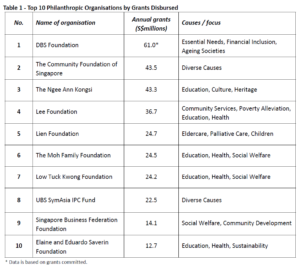
In the first place is DBS Foundation, which is estimated to have committed approximately S$61 million in 2025. This builds upon DBS Foundation’s commitment of up to S$1 billion over the next 10 years, with over S$160 million committed since 2024 to support 48 Businesses for Impact and 29 new impact programmes.
In second place is the Community Foundation of Singapore, with S$43.5 million in annual grants. As a donor-advised fund sponsor, it helps individuals, families and organisations channel their giving across diverse causes, supported by knowledge of community needs and grantmaking expertise.
The Ngee Ann Kongsi ranks third, with S$43.3 million distributed to education, culture and heritage causes, continuing its longstanding tradition of supporting educational, cultural and charitable initiatives.
Lee Foundation ranks fourth at S$36.7 million, supporting community services, poverty alleviation, education and health. Lien Foundation occupies fifth place, with S$24.7 million in grants for causes including eldercare, palliative care and children. Its focus on specific social needs offers a contrast to grantmakers that support a wider range of causes.
The Moh Family Foundation is sixth, with grants of S$24.5 million across education, health and social welfare. Low Tuck Kwong Foundation follows closely in seventh place at S$24.2 million, also supporting education, health and social welfare causes. In eighth place, UBS SymAsia IPC Fund reports S$22.5 million in grants for diverse causes.
Singapore Business Federation Foundation is ninth, with grants of S$14.1 million supporting social welfare and community development. It returns to the Top 10 after featuring in the 2022 and 2024 editions. The Elaine and Eduardo Saverin Foundation rounds out the Top 10 at S$12.7 million, supporting education, health and sustainability. It first appeared in the Top 10 in the 2025 edition and remains among the leading grantmakers in 2026.
While the ranking is based on individual philanthropic organisations, some larger groups advance their social missions through multiple entities and giving vehicles. One example is NTUC Enterprise, whose NTUC Community Fund, FairPrice Foundation and Income OrangeAid reported combined disbursements of nearly S$23 million in FY2025. If considered collectively, the contributions of the NTUC Enterprise’s giving vehicles would rank eighth, between Low Tuck Kwong Foundation and UBS SymAsia IPC Fund. This provides an additional perspective on the scale of philanthropic giving through such organisational groups.
From Grants Disbursed to Expenditure
While the Grants Disbursed ranking captures funding provided to external organisations and beneficiaries, it does not reflect the full range of resources that philanthropic organisations commit to their causes. Beyond grantmaking, some organisations also develop and run programmes and initiatives directly, using their own resources and capabilities. Ideally, expenditure on these activities would be identified separately to provide a more complete picture of their contributions to social causes. However, as financial disclosures do not consistently distinguish such spending from other expenses, Total Expenditure is used as a broader proxy. This measure also includes costs associated with running the foundation, maintaining its assets and other operational activities that may not directly contribute to social causes.
The Total Expenditure ranking provides an additional perspective on the scale of philanthropic activity, although it should not be interpreted as a direct measure of spending on charitable programmes or social impact. The 160 philanthropic organisations recorded combined expenditure of at least S$608 million, approximately 25% higher than their total grants disbursed. Of these, 66 organisations recorded annual expenditure of at least S$1 million each.
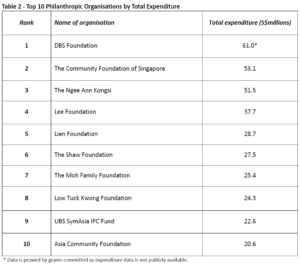
The top 10 organisations accounted for at least S$352 million, representing more than half of the total expenditure recorded. Each reported annual expenditure of at least S$20 million. The composition of the Top 10 differs slightly between the two rankings, with The Shaw Foundation and Asia Community Foundation featuring in the Total Expenditure ranking.
Data Collection and Methodology
This is the fifth edition, following reports published in 2021, 2022, 2024 and 2025. As in previous editions, the focus is on private philanthropic organisations registered in Singapore and identified through the Inland Revenue Authority of Singapore and/or Commissioner of Charities.
Organisations excluded from consideration include philanthropic organisations that are politically affiliated, faith-based, or government-related. Faith-based and politically affiliated grantmakers are excluded because many do not publicly disclose their grantmaking amounts or activities, and some restrict grants to recipients of the same faith. Similarly, funds and trust entities established for specific charities, such as school funds designated exclusively for their beneficiaries, are not considered. Organisations that have suspended their activities or are in the midst of deregistration are also excluded. To maintain a focus on private philanthropy, government-affiliated grantmakers are not included.
Data was compiled mainly from publicly accessible sources, including annual reports, the Charity Portal, and official organisational websites, between September and November 2026. Figures are standardised to Singapore dollars, and the ranking is based on the most recent annual grant disbursements between Financial Year 2025 to 2026. The majority of the data come from Financial Year 2025. Organisations with data earlier than 2024 as well as those with no publicly available grant data are unranked.
For philanthropic organisations that disclose annual grants disbursed but not total expenditure, the grant amounts are used as a proxy for expenditure. This generally provides a conservative estimate, as total expenditure includes grants alongside expenses associated with operating programmes, administering the organisation, maintaining assets and other activities. Actual expenditure may therefore be higher than the reported grant amounts.
The two rankings should not be summed, as grants are generally included within total expenditure.
Limitations
This report relies on publicly available data. Some philanthropic organisations in Singapore may not be registered as charities with the Commissioner of Charities or listed as grantmakers with the Inland Revenue Authority of Singapore. These may include family offices that allocate a portion of their resources to grantmaking, or philanthropic funds established by donors and managed by private banks in Singapore. Due to the lack of publicly available information, such entities are not included in the list.
Grant amounts were primarily obtained from financial statements or annual reports. In cases where data lacked clarity or detail, reasonable assumptions were made to estimate the grant amounts disbursed. For a limited number of organisations, only grant commitments were available publicly, and these were used as proxies for disbursements.
Where total expenditure figures were not publicly available, grants disbursed were used as a proxy for total expenditure. Total expenditure should not be interpreted as a direct measure of programme spending or social impact. Exceptional grants or project-related expenses may also result in significant year-on-year fluctuations.
A small number of philanthropic organisations requested to be excluded from the ranking, and these requests were respected.
Looking Ahead: A More Collaborative Philanthropy
The 2026 edition of Singapore’s Biggest Philanthropic Organisations highlights how philanthropy is evolving beyond traditional grantmaking. While financial contributions remain essential, philanthropic organisations are increasingly exploring how their expertise, networks, infrastructure and other resources can be put to work to create greater social impact. Whether through developing programmes, strengthening existing organisations or bringing together partners, the emphasis is shifting towards how philanthropic resources and capabilities can be deployed most effectively to address social needs.
Looking ahead, greater collaboration will be important in realising the full potential of philanthropy. No single organisation possesses all the expertise and resources needed to address complex social challenges. Philanthropic organisations, businesses, charities and community groups each bring different strengths, from financial resources and professional expertise to operational capabilities, community relationships and frontline experience. By recognising and leveraging these complementary strengths, organisations can develop more effective solutions and achieve greater impact together.
As Singapore’s philanthropic ecosystem continues to develop, there are opportunities for deeper partnerships, greater sharing of knowledge and resources, and more sustained investment in strengthening organisations across the sector. Ultimately, Philanthropy at Work is not just about how much is given or spent, but how capital, capabilities and communities can come together to create meaningful and lasting impact for society.
Acknowledgement
While the majority of information in this project was obtained from publicly available sources, there were a select few foundations we reached out to for additional details. We would like to express our appreciation to those who kindly responded and supported the accuracy of this work. Our thanks also go to NTUC Enterprise for their valued collaboration on the case study presented in this report.
The full list of 160 grantmakers with information on their annual grants, total expenditure, cause areas as
well as contact details is available for purchase at S$100. Please click here for the purchase.
To download the public report, please click here to download.

